
I finally completed the last of the five sections of “The Coast,” and made some final small changes to the rest of the composition. Of course, nothing is ever really finished, but I’m happy enough with it to share it with you! The full playable export is here. To see a detailed analysis of the music and the “program” it attempts to portray, see the piece’s project pages here.
The entire composition ended up being longer than anticipated, just short of 11 minutes. The main reason was the last section, “Footprints.” I had intended it to be just like the others: about the same time length, focused on the section’s programmatic theme (in this case, the closest, microscopic perspective of the coast). But being as the section also ends the composition, I had a bit more to do than the simple descriptive approach the previous four sections used. (If all this sounds like nonsense, you’ll need to do a bit more reading in the project home page and individual section pages!)
I hate endings! (Not being finished, silly, that’s just wonderful!) Creating a musical ending requires effort from the composer’s perspective. Popular songs sneak past this problem with simple forms (verse/chorus/verse/chorus/bridge/verse/chorus is the most common) which everyone knows, so we all know when the end is imminent. Lyrics also help. And, of course, most songs remove the need for hard ending work by simply fading away.
Large orchestral works can leverage the same tricks, but they rarely do, and I wasn’t interested in trying that here. That means I’m tasked with creating through music a series of emotional experiences which the listener recognizes as nearing an end. I did an entire blog posting on this, “Cadence.” If you read that, you’d know that my approach to this problem doesn’t flow naturally from the styles of older composers, but since I also haven’t embraced popular song solutions, I don’t have any neat formulae to use. So the ending I’ve settled on might end up changing, but…
Don’t get me wrong, I’m really very happy to have this one, as they say, in the can!
This has been the most complex, most demanding project I’ve ever completed. Not just because it’s long (I’ve written longer). It uses a fair number of instruments I’ve never written for before (see below). And, with this large of an ensemble, finding groups of instruments which will best serve the musical ideas I’m chasing requires a LOT of experimentation and study. And, simply keeping track of this many instrumental staves — 49, representing 46 instruments played by 42 instrumentalists — is a battle. Since I work by ear, all too often when one instrument is hitting a bad note (I can hear it!), finding it requires quite the hunt!
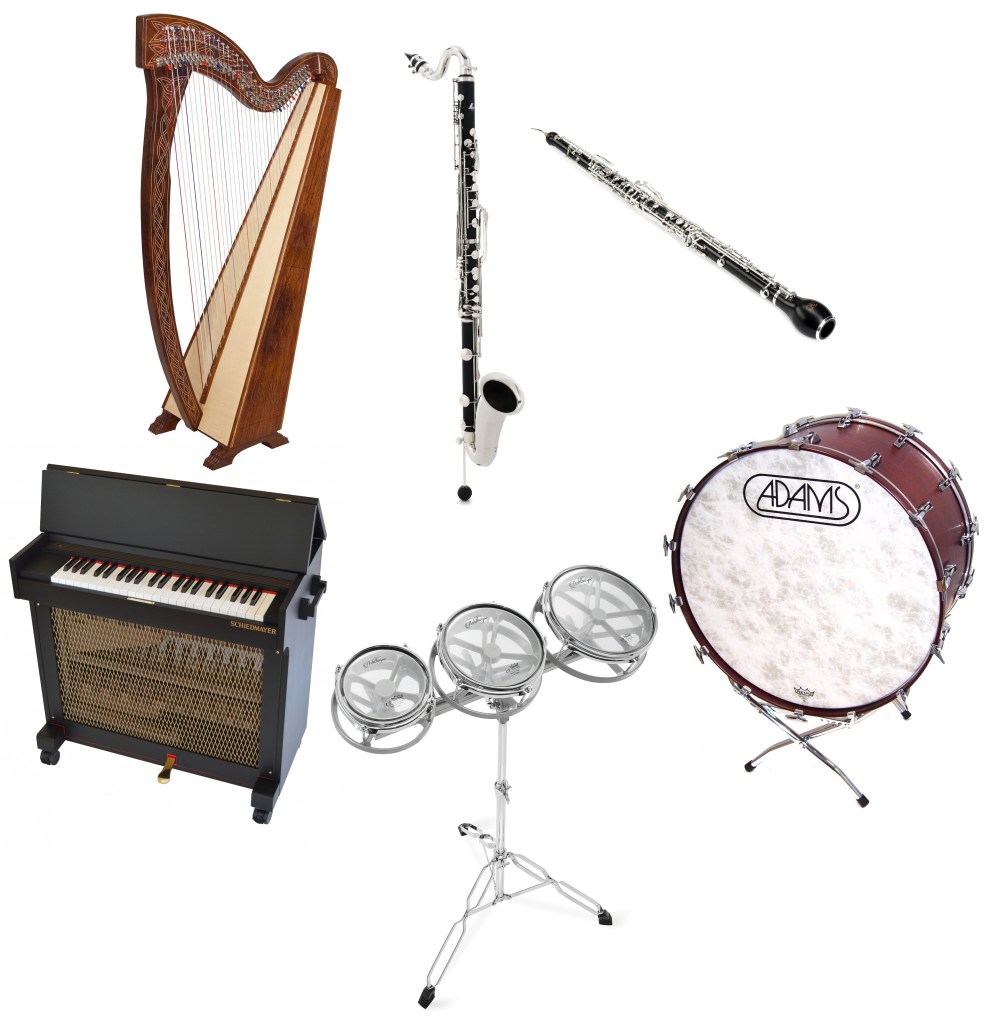
Here are a few of the instruments for which I’ve written for the first time in this composition (not to scale, clockwise from upper left, with the sections they appear most prominently):
Orchestral harp (“Aloft,” “Footprints”)
Bass clarinet (throughout)
English horn (“Footprints”)
Bass drum (“Storm”)
Roto-toms (“Storm” — I actually use 5)
Celesta (“Aloft”)
Despite the effort, this piece is now my favorite so far. It’s a real joy for me to listen to, and the virtual instruments are good enough to be satisfying. And that’s good, because it’s also the least likely composition of mine to ever get an actual live performance — there aren’t exactly a lot of orchestras wandering around looking to take on such a project, from a virtually unknown composer. I will continue to work on this composition as if it were possible, just for the experience: I must edit individual instrumental parts, and a conductor will need a somewhat-simplified conductor’s score.
But if I ever get a “call,” the full score and individual parts will be ready!
“5: Footprints” is discussed and presented on its own page here. You can hear the full project here. And, of course, the work has a project page, which has full details, here.

 Jeffrey L. Jones, Composer