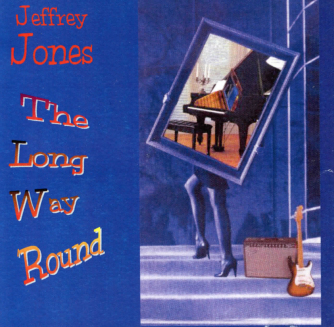
This is the original CD cover design, courtesy of sister Karen Jones. It was quite literally “clip art,” images cut from magazines with scissors and pasted together as a collage.
This page is radically different, since it serves as a way to deliver access to the only recordings I’ve retained of my singer-songwriter period. You won’t find any “classical” pretentions here, no video exports of music scores. The links below are to MP3’s of most of the original songs from the CD. They were recorded in the late 1990’s, though almost all of the songwriting is much older than that (my first attempts at songwriting date from 1975). MIDI data pushed to a synth module provided the instruments I wasn’t comfortable playing myself, but all voice and guitar channels are actually me, recorded on a digital 8-track I rented for the purpose. I was still a teacher at a local high school at that time, so I “mastered” the recordings and burned individual CDs of the album there.
My career as a songwriter and pop/rock instrumentalist/vocalist spanned several decades, starting as a solo singer-songwriter/acoustic guitarist playing small venues, then joining a band for a time as a lead vocalist. I never attempted to market the CD’s songs, since the recording occurred long after I’d given up such pursuits. (Although much is listenable, there’s plenty of evidence that this wasn’t a professional recording studio product! But I did some of my best guitar work on this CD.)
Notes on individual songs follow.
You’re Not Trying Hard Enough. This song is an exception to the others — it was written specifically for the recording project, so I never performed it elsewhere or previously. The lyrics were a send-up of my checkered personal life, an observation that negative things tended to define the seriousness of my romantic relationships. Since I had just married my current wife Dee, and she treated me so much better than any of the objects of past affection, this lyric set is a tongue-in-cheek observation that things were different. The arrangement is considerably more “pop-ish” than the others, since I was having a lot of fun writing for a virtual (as in non-existent) band made up of instruments I would love to have had access to during the active part of my pop music career.
Chasin’ You Blues. This song was written very early in my “career,” an attempt at a modified 12-bar blues. The lyrics make a lot of sense in the context of “…trying…” above. I frequently performed this song in my early solo career on acoustic guitar, but I’d always longed to “hear” it like it is here, with electric guitar and full rhythm section. (It’s PG-13 for language and some sexual content.)
Lucifer’s Shadow. The lyrics’ mood is dark. I gave this arrangement a string setting, probably the first time I’d written for strings formally, using a very crude manuscript software package, and the low-quality synth module playback — all that fit my very limited budget at the time.
The Long Way ‘Round. This song was written for a band I’d joined in the late 1970’s, specifically as a vehicle for a very gifted soprano saxophone player who was perhaps 18 at the time — he opened the song by himself, then at the end, the other instrumentalists left the stage one at a time until he was once again by himself, improvising as a soloist. We usually closed a set that way. When the band broke up, I attempted and failed to get a recording of the song played by the band, so this arrangement is the best I could do. The lyrics were about characters/events appropriate to the rougher parts of downtown Cincinnati.
Tom Cat Blues. This song received probably the only real attention I ever got as a songwriter, winning 2nd Place in the singer-songwriter category of the national American Songfest annual contest. (No idea whether that late 1970’s entity is at all related to current contests.) I’d recorded it, and three other songs, in London, where brother Christopher had managed to recruit a producer with a crude home studio, and a drummer (Pick Withers of Dire Straights fame). I sent that cut off, which produced the “win,” and a letter from an LA producer promised by the contest — which, not surprisingly, went nowhere. This recording isn’t that, since that tape is long gone, but the electric guitar work improves on it. The lyrics are about the limitations to a wild life placed by the aging process, written at a time when I had only the vaguest sense of what that meant.
One More Try. The band I sang lead in for the last year’s of the 1970’s was pretty much straight-up instrumental jazz-rock. Although this very autobiographic song was written before I joined them, the jazz feel fit perfectly. Unfortunately, this “recording” attempts to conger up the band’s arrangement, without the presence of those great chops players. But the song comes through.
The Adolescent Mind. This is also a vague attempt at a jazz feel, this time following the lead of a favorite of mine, Mose Allison. My youngest (the adolescent of note) feels like I was a bit fast-and-loose on the facts (he was never a fan of pork rinds, to be clear), but no self-respecting songwriter ever let mere facts get in the way of a good story.
Freedom Seas. This is probably the most autobiographic of them all. The subject of the song is a player trying to make it in the big city. The physical setting, and the fantasy world he comforts himself with, are real, though other details are more general. But I’m probably proudest of this lyric set than almost anything I’ve ever written.
“…Each day that creeps by, tired and ashamed,
Always coming up short of yesterday’s claims,
And promising much for tomorrow to provide,
Bridged by the darkness where Maria lies tied…”

