The Coast
As per my habit, this page is dedicated to music theoretical analysis, though the page could serve anyone interested in knowing more about the musical content.
In a composition a bit over 10 minutes, a lot of things are happening, with five thematic centers provided by the sections’ programmatic ideas (see The Coast‘s main project page for that). But this composition is extremely efficient in its use of music motific content. In fact, almost all of the musical ideas can be derived in some way from the material of the first 15 seconds or so of the entire work. On this page I’ll show you the pieces, and draw the connections between them.
Main Motif (Piccolo)

This motif (beginning measure 4) is the closest the composition gets to an actual melody, made even sweeter by its being pitched quite high (for programmatic reasons — it’s a bird!). As is my habit, the tonal basis (Lydian scale in F) is only hinted at, though the harp accompaniment motif gives a better grounding of that. (For a playback of this opening with the other instruments, see “Celesta Motifs” below.) Its slightly odd timing (note values crossing measure lines) is simplified when it appears in the oboe (here with clarinet, measure 12)…

…and other instruments, including bass clarinet. Note that the above loses the Lydian raised 4th, but the similarity is still there. The trumpets (with the trombones) pick it up, triumphantly (as trumpets are wont to do!), a bit later in the section (measure 28).

Opening Harp Motif

This motif serves as a simple accompaniment figure to the piccolo, but appears in a variety of forms all over the rest of the composition. And, if you strip out the ornamentation (with a few other small changes), the result carries the beginnings of the second section, “Storm” (also Lydian, here in G, measure 52):
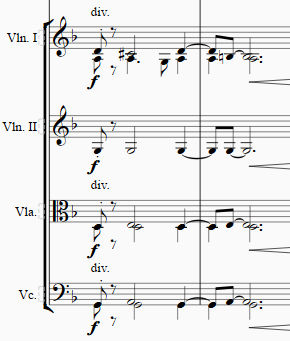
The crashing percussion at the very beginning of “Storm” foreshadows the above motif from a rhythm-only perspective (measure 49):

But not to be outdone, the third section, “Boardwalk,” starts with a delightful (may I say?) trombone solo (with the tuba in tow, measure 89), which owes its existence to the same motif.

The resultant melody line is simply repeated 4 times, followed by a few changes and augmentations, and using a lot of instrumental and polyphonic variation. That’s pretty much the entirety of that section, a form that hints at the program for a “boardwalk.”
Celesta Motifs

The opening Celesta line (beginning measure 4 – the playback includes the other instruments from the very beginning of the composition) has a couple of contributions to make. The glissando immediately preceding the piccolo line gets fleshed out and more succinct later, first in the 1st violin (measure 21, with supporting strings, and woodwinds)…
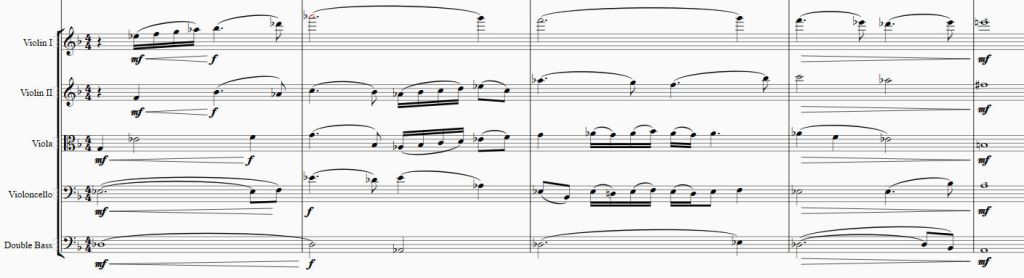
…and in the horns (with trumpets, measure 39) with much more dramatic effect:

Notice that the little motific “turnaround” in the celesta line also does duty here. Throughout the composition, variations of both can be found in strings, woodwinds, even the tympany (in mostly rhythmic form).
“Beach”

This section gets its own place in the motif list, since it’s the only one which has its own distinct motific content. (You could postulate that it distantly relates to the opening harp motif, but that’s really a stretch.) The above theme excerpt is from measure 169. It opens and closes with some very active and fast string work — with the full string section to open (measure 143, below), and string solos to close (measure 200).
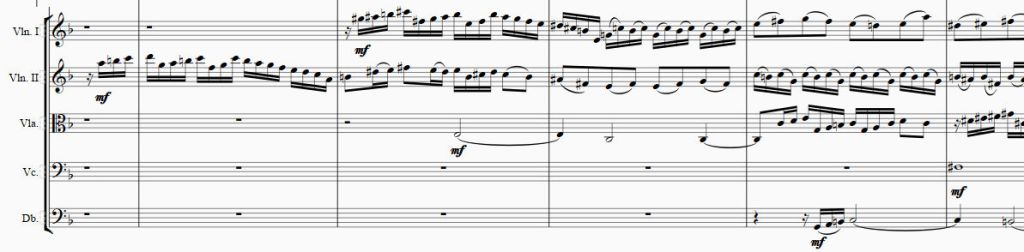
The introduction and closing figures cover nearly half the section, but it, and the main theme at (starting measure 161), really stand on their own, reflecting the playfulness of the programmatic idea.
Since the last section (“Footprints”) serves double duty as a portrayal of its programmatic material and as a thematic recapitulation to close the work, nearly every motific piece makes an appearance in that section, and nothing new is introduced.
 Jeffrey L. Jones, Composer