I’ve spent the last day walking through this blog, intending to get things organized by topic. (That’ll happen, it’s coming!) I was reminded about how much time and effort are invested in these little stories! Since this is a website about music, I’ll plunge back into it with gusto!
[Music has several primary characteristics. In a series of blog postings I’m calling “Music in Pieces,” I’m going to look at them one at a time from the perspective of my own work here. Now that I have a “body of work,” I can speak to how I handle each “piece” generally.]
We’ll start with rhythm. (If you’re not a music person, no worries, you still probably “walk with rhythm.” Everybody has a bit of it in them, and it doesn’t even require what we generally refer to as an ear!)
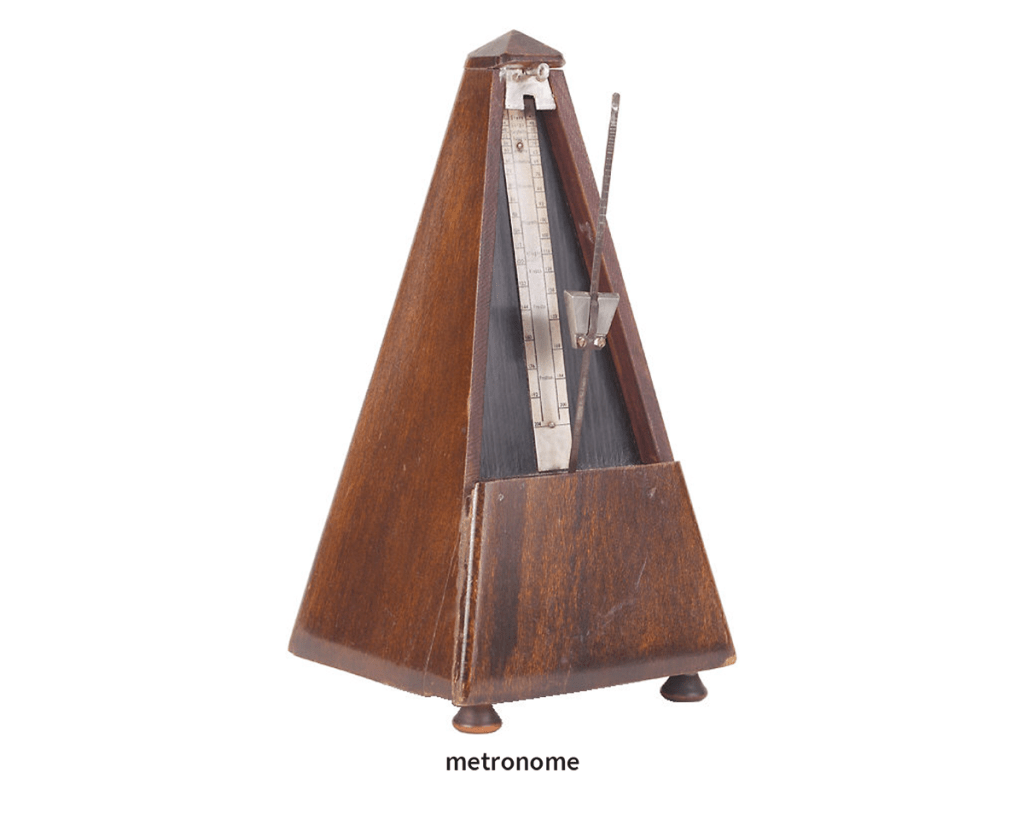
A composer’s approach to the world of rhythm can vary wildly. Most popular music has one of the simplest approaches, since it often selects a fairly simple rhythmic pattern and hangs onto it through the entire song. (In so-called “serious music,” the Minimalists went even further, making simplistic repetition more than just a thing, but the whole focus of the music.) At the other extreme, a lot of 20th and 21st Century composers blow that up completely, with jagged changes in emphasis and meter happening throughout a composition. (The metronome above is a practice staple for many instrumentalists, but is much more useful in the first case, less so in the second!)
I, not surprisingly, am somewhere in the middle. Having spent a large amount of my musical time in rock bands, I respond emotionally to strong repeating rhythmic patterns. But I’m also a mathematician with attention deficit disorder. Rhythm is nothing if not mathematical (dividing up time with mathematical patterns), and there are soooo many other mathematical patterns besides the simple ones. If all of my works here were in 4/4 (groups of four beats), my mathematical/ADD mind would doze off and lose focus. As a result, my work leverages some unusual rhythmic approaches which, nevertheless, appear consistently through a piece or section. My charge to myself as a composer is to make sure that the other characteristics of sound (melody, harmony, timbre) make the rhythmic choices seem natural, accessible, attractive.
A perfect example of this is “September,” a tone poem I deliberately wrote in 7/4 and 7/8 time for non-musical reasons (“Septem” means 7 in Latin). But I’m consistent — I don’t vary from the 7 beats per measure throughout, but by the end, I’d like to think that this odd rhythmic pattern stops being remarkable, since the melodic and thematic characteristics seem so natural.
Sometimes my rhythmic choices are intentionally dramatic. The “Errant Waltz” doesn’t stay in 3/4 throughout. Its 3-3-3-2 structure means I’m thumping your ear with a “short” measure every fourth, which I emphasize with accents and other jarring stuff. The result is an interesting variation on the boring 3-3-3-3 waltz. (Of course, once I get to the B section which leverages a traditional Irish waltz, I feel obligated to break that pattern some.)
I especially take delight in using much older, historically traditional music forms with associated rhythmic approaches, and modifying them in interesting ways. The entirety of Je danse, J’apprends is like that, from the “Spagnoletta,” a fast 3/4, whose phrasing refuses to stay in the traditional blocks of 4 measures, to a “Reel” that insists on including a nice melodic line over the top of otherwise fast-and-furious reel-like content. The Brass Variations also uses this approach, although the forms there aren’t historical, but rather simply conceptual. (A “Chase” isn’t a musical form so much as an idea that might imply one.)
The above rhythmic ideas cover an entire piece, or section — that is, they’re “macro.” I also like to use rhythm in “micro” ways, as a part of the things I build melodies and change with. As “September” moves from the opening “A” section towards “B,” you can hear the tympani tapping a rhythmic idea underneath the brass and strings. In the middle of “B,” when things have quieted, the strings pizzicato that same rhythmic theme, but with pitches. To be sure you don’t miss the connection, the tympani follows immediately with the original idea as it was first mentioned.
Motific development is full of these sorts of little details, with a goal of providing the listener with familiar pieces throughout a composition, increasing the chance things will become pleasurable with familiarity. My compositional style may produce a lot of such self-similarity, but it often happens almost subconsciously — composers want you to believe they’re genius, assembling a small number of musical ideas with slight variations into huge works by pure brute force of logic and skill. In fact, many (me included) “discover” a lot of these things as they work. The skill then is how one cleans up and systematizes the small pieces of a large work after the fact.
Great art through discovery is a fun concept. But the hard work is still there!
There are a lot of rhythmic things I’ve also “discovered” and leveraged in my work here. Je danse, J’apprends also has several polyrhythmic spots — pitting 3/4 and 4/4 against each other at the same time is a common one. But I think I’ve written enough for one day.
Yup, “I’ve got rhythm,” but I’ve got other stuff, which I’ll write about in future blog postings.

